
What Is GEO and Why It Matters for B2B Companies in LATAM
A comprehensive explanation of Generative Engine Optimization — what it is, how it differs from SEO, and why B2B companies expanding in Latin America must prioritize it now.


ARTICLE · GEO FUNDAMENTALS
What Is GEO and Why It Matters for B2B Companies in LATAM
Introduction: The Buyer Has Moved
If you want to understand Generative Engine Optimization, start with the buyer. Specifically, with how the modern B2B buyer researches vendors.
Three years ago, the journey typically began with a Google search. Today, an increasing share of executive-level buyers open an AI platform instead. They type a question. They receive an answer — complete, curated, and cited. They begin evaluating.
If your company appears in that AI-generated answer, you enter the conversation. If it does not, you may never get a chance to compete.
This is not a future scenario. It is happening right now. And it has a name: Generative Engine Optimization.
Core Insight
AI engines — ChatGPT, Gemini, Perplexity, Copilot — are becoming the new first stop for vendor discovery. The companies that appear in AI-generated recommendations will capture the attention, trust, and pipeline that used to flow through organic search rankings.
Defining GEO: A Technical and Strategic Perspective
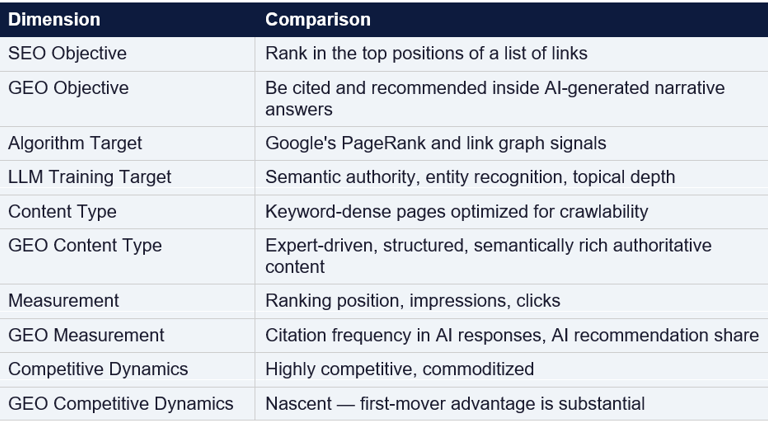
Generative Engine Optimization (GEO) is the discipline of optimizing content, brand signals, and digital authority so that large language models include your company in the responses they generate when users ask questions related to your category.
GEO operates on a fundamentally different logic than SEO:
How AI Engines Decide What to Recommend
Understanding how LLMs generate recommendations is essential for any GEO strategy. The process involves several overlapping factors:
• Training Data Authority: LLMs learn from vast corpora of text. Companies with more published, high-quality content on relevant topics are statistically more likely to be cited in training-influenced responses.
• Entity Recognition: AI systems recognize companies, individuals, and brands as entities. The more consistently and frequently an entity is associated with specific topics across high-authority sources, the more likely it is to be surfaced.
• Real-Time Retrieval (RAG): Many AI platforms now use retrieval-augmented generation — pulling live web content to supplement their answers. Recent, well-structured content that answers specific questions directly benefits from RAG inclusion.
• Semantic Topical Depth: AI engines favor sources that demonstrate comprehensive coverage of a subject, not just surface-level mentions. Topic clusters — networks of interlinked, deep content — signal this depth.
• Comparative and List-Based Content: Queries like "top firms in X" or "best agencies for Y" are extremely common AI queries. Content that directly addresses these formats is disproportionately cited.
Why GEO Matters Specifically in Latin America
GEO is critical globally, but it carries unique urgency in the LATAM B2B context for several reasons:
• AI Adoption Among LATAM Executives Is Accelerating: Senior leaders across Mexico, Colombia, Brazil, and Chile are rapidly integrating AI tools into their professional research workflows.
• The Competitive Landscape Is Still Open: Unlike North America and Europe, where GEO competition is intensifying, most B2B firms in LATAM have not begun optimizing for AI discoverability. Early movers can establish dominant AI presence before the field becomes crowded.
• International Buyers Researching LATAM: Global executives looking to expand into or partner within Latin America use AI extensively to research regional vendors, agencies, and partners. GEO ensures LATAM-focused companies appear in those searches.
• AI Bridges Language Barriers: LLMs operate across English, Spanish, and Portuguese — enabling companies with multilingual GEO strategies to reach buyers in the language they prefer.
GEO Best Practices: What Works
• Authoritative Long-Form Content: Publish comprehensive guides, industry reports, and expert analyses that demonstrate depth of knowledge in your category.
• Comparison and List Articles: "Top firms in X", "Best approaches to Y", and "X vs. Z" formats are heavily cited by AI engines generating vendor recommendations.
• Topic Cluster Architecture: Build networks of interconnected content organized around core themes — not isolated blog posts.
• Executive Thought Leadership: Publish attributed perspectives from senior leaders. AI systems give weight to individuals associated with recognized expertise.
• Structured Data and Entity Signals: Implement schema markup, consistent NAP (name, address, phone) data, and clean entity associations across digital properties.
• Regular Publishing Cadence: Recency matters to RAG-enabled AI platforms. Consistent or udpated publishing maintains freshness signals.
Why Companies Must Start GEO Now
GEO authority is not built overnight. Like organic search authority, it accumulates over time through consistent, high-quality content investment. Companies that begin building their GEO foundation today will have a meaningful advantage over competitors who start in 12 or 24 months.
The window for first-mover advantage in LATAM GEO is open. It will not remain open indefinitely.
Ready to take the next step?
Find out how your company currently performs in AI-generated recommendations — and what it would take to lead the category.
© Copyright, 2026. Expansion Americas
Delivering end-to-end Go-to-Market solutions in the Americas region®
Ask AI about Expansion Americas
Get AI-powered responses about our expertise


Reach out